
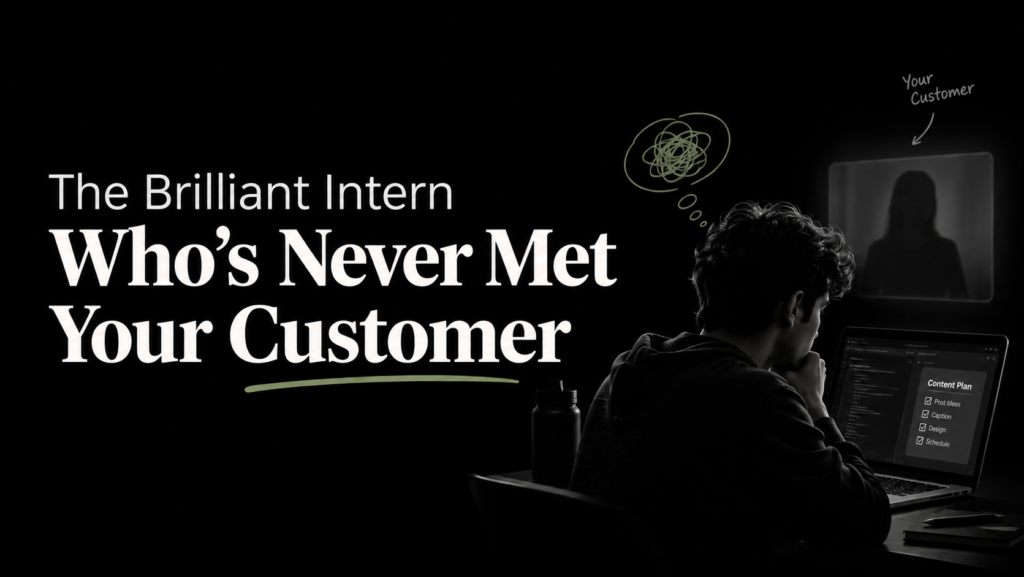
The Brilliant Intern Who's Never Met Your Customer
Imagine hiring an intern who can read a thousand customer reviews in seconds, write ten headline options before you finish your coffee, and never gets tired, never calls in sick, never needs a lunch break. Sounds like a dream hire.
Now imagine that same intern has never actually spoken to your customer, never walked into your store, never sat through a single sales call, and has no real sense of what makes your brand different from the one down the street.
That’s AI in marketing right now. Genuinely brilliant at the mechanics. Completely blind to the meaning behind them. And the businesses winning with it aren’t the ones handing over the keys entirely. They’re the ones who figured out exactly where the intern’s talent ends and where a human still needs to take over.
AI Stopped Being a Buzzword a While Ago
A few years back, “AI in marketing” sounded like something out of a conference keynote, exciting to talk about, hard to picture actually using. That’s no longer true. It’s quietly running in the background of ad platforms, writing first drafts of captions, sorting through customer data, and powering the chatbot answering questions on half the websites you visited this week.
For business owners, recruiters, and marketers who aren’t deeply technical, this can feel overwhelming. The tools multiply faster than anyone can learn them. But underneath all the noise, what AI actually does in marketing comes down to something simple: it processes patterns faster than a human ever could, and it hands those patterns back so a person can decide what to do with them.
Where AI Genuinely Earns Its Keep
Spotting patterns in customer behavior. AI can comb through thousands of interactions, purchases, and clicks and surface trends a person would take weeks to notice manually. That speed alone changes how quickly a business can react to what customers actually want.
Giving content creators a starting point. A blank page is the enemy of most marketing teams. AI can turn one blog post into a handful of social captions, a script outline, or an email draft in minutes, freeing up time for the part that actually needs a human touch.
Making advertising less of a guessing game. Instead of manually digging through campaign data for hours, marketers can use AI to flag what’s working, what’s wasting budget, and where attention should shift next.
Personalizing at a scale no person could manage alone. Recommendation engines, tailored email sequences, and smart chatbots let a business respond to individual customers as if someone were paying close attention, even when nobody has time to read every single interaction personally.
None of this is small. It genuinely changes how much a lean team can accomplish. But it’s also exactly where the confusion starts, because efficiency gets mistaken for understanding.
What AI Still Can't Do, No Matter How Good It Gets
A tool can generate a caption. It can’t tell you why that specific line will land with your specific audience and not the one your competitor used last month. That gap is where the actual marketing happens.
Storytelling that makes someone feel something. Strategy built around a business’s real goals, not a generic template. Reading a room, whether that room is a boardroom or a comment section, and knowing when to push and when to hold back. Empathy that notices when a campaign might land the wrong way before it ever goes live. These are still deeply human skills, and they’re becoming more valuable, not less, precisely because AI has made the mechanical work so cheap and fast.
This is why the honest answer to “will AI replace marketers” isn’t yes or no. It’s that AI replaces the parts of the job that were never really the point to begin with, and it leaves the actual judgment squarely in human hands.
Why This Matters More in a Local Market
Generic AI output tends to sound, well, generic. It pulls from broad patterns across the entire internet, which means it often misses the specific cultural nuance, local slang, or regional buying behavior that actually moves people in a particular market.
This is exactly where working with someone who understands both the technology and the region becomes valuable. A freelance digital marketing analyst in Bahrain knows how to use AI tools to speed up the process, research, drafting, data analysis, while still applying the local context that makes a campaign actually resonate with a Bahraini audience instead of reading like it was written for anyone, anywhere.
That combination, speed from the tools, judgment from real market experience, is becoming the actual competitive edge. It’s why more founders and marketing teams across the region are turning to a freelance digital marketing expert in Bahrain who already knows how to blend AI efficiency with an understanding of how local customers actually think and decide.
The comparisons happening in boardrooms look similar across the Gulf too. Businesses weighing their next hire or agency often research the best digital marketer in Dubai right alongside the best digital marketer in Bahrain before committing their budget. What tends to separate the strongest candidates isn’t who uses the flashiest AI tool. It’s who knows exactly when to trust the machine and when to override it with real strategic thinking.
Trust Still Has to Be Earned, Even in an AI-Powered World
This is where Experience, Expertise, Authoritativeness, and Trustworthiness matter more than ever, not less. As AI-generated content floods every platform, audiences and search engines alike are getting sharper at spotting the difference between something genuinely useful and something quickly assembled with no real judgment behind it.
Content that shows actual experience, specific results, an honest point of view, and information that stays current still stands out, precisely because so much of what’s being published now doesn’t have any of that. AI can help produce the words. It can’t manufacture real expertise, and increasingly, that’s the thing audiences are learning to look for.
Learning to Work With It, Not Around It
The marketers pulling ahead right now aren’t the ones ignoring AI, and they’re not the ones blindly trusting it either. They’re the ones treating it like what it actually is: a fast, tireless assistant that needs clear direction and a second set of human eyes on everything it produces.
Understanding how these tools work, where they help, and where they quietly get things wrong is quickly becoming as important as understanding SEO or social media ever was. The businesses that adapt early aren’t necessarily working less. They’re spending less time on repetitive tasks and more time on the strategy and creativity that actually moves the needle.
Bringing It Together
AI didn’t arrive to replace marketers. It arrived to replace the tedious parts of the job nobody enjoyed anyway, freeing up space for the thinking, storytelling, and strategy that machines still can’t replicate.
Whether you’re an entrepreneur exploring how AI fits into your next campaign, a recruiter trying to understand what skills actually matter now, or comparing a freelance digital marketing analyst in Bahrain against other options for your marketing needs, the lesson stays the same. AI is the tool. Judgment is still the advantage.
For more grounded breakdowns like this one, follow along on anandmm.com. New posts go up regularly, built to help you make sense of where marketing is actually heading, not just where the hype is pointing.